Saturday, 25 February 2017

"I'm sick of politics"...


How often have you heard or read that? 

Every day I see letters and social media comments, I hear people complaining about the state of the roads, the time to wait to see a GP, the rising cost of everything, yet if I suggest gently that the complainer could help change things, the response is often, "I'm sick of politics..." or "I don't do politics..." or  even "all politicians are as bad as each other..."

But that's not helping to make things better.


Politics affects us all, whether we like it or not. 

We can choose to ignore it but we are still affected.

Physically, mentally, emotionally, financially, we are affected by political decisions every day of our lives.

Those potholes in your road? That's politics.

Library or museum closed? That's politics.

Can't get an appt with a GP for 2 weeks? That's politics.

Have to wait 6 months for an operation? That's politics.

Elderly relative getting 2 x 15 minute care visits per day? That's politics.

Being sanctioned by benefits assessors? That's politics.

Having to pay ridiculous amounts in rent because of a shortage of affordable housing? That's politics.

Can't afford to travel on trains? That's politics.

Losing the right to move freely within, or to live and work in the EU? That's politics.

Leaving university with a debt of almost £30k? That's politics.

Still think politics is sickening?

So do I, but I am prepared to stand and fight against the system that causes the problems that people face every day. If you won't do that then you are part of the problem, by not standing against it you are tacitly consenting to it. Get political! Join others in a local party or campaign! Stand up and be counted! Fight back!  

Together we are stronger than we can ever be alone.  Make a difference!

Wednesday, 8 February 2017

Don't call me Mrs....!!!

Should married women be addressed as Mrs (husbands-name) or is this a throwback to when women and their possessions were owned by their fathers and passed to their husbands on marriage? Is there a place in modern society for such subordination of a woman's identity? There are still men who feel that possession is part of marriage, I hope that there are fewer such believers as time passes, but I fear that's not the case.


Throughout history that bastion of religion, the Bible and its interpreters, have told us that women belong to men, that women's bodies belong to their husbands, and that women are and should be subservient to their husband. Indeed it is not that long ago that women were permitted (!) to remove the promise to "obey" their husbands from their marriage vows!

The interpretation of possession seems to be based on the text from 1 Corinthians 7:4 which makes reference that "the wife hath not power of her own body but the husband", but is often taken out of context so as to reinforce the notion of male ownership and possession of the wife. In fact, the text does not state that she is a possession of the husband, it says that a husband and wife have an equal responsibility in the "power"  (i.e. possession) of each other (i.e. a partnership) and it also explicitly states, "But I speak this by permission, and not of commandment."  So to those who use the Bible as their justification for this subordination of women as chattels of their husband I say, go back and re-read that section! Women are not your possessions in marriage, they are your partners.

Possession versus Perception?
So, why do we still insist on addressing a married woman as Mrs (husbands-name), whereas we would refer to a woman co-habiting or in a same sex marriage by their own name?

Where women use their own name for work / professional reasons should should they be called Mrs (husbands-name) at other times? 

Should we do away with the whole business of Miss, Ms and Mrs for women, which perpetuates the hierarchy of marital possession?  It is impossible to tell if a man is married by his being Mr (surname) but for women using Mrs (surname) has implications (she is married or divorced or widowed), whilst Miss (surname) shows she is unmarried (or has reverted to her maiden name) whilst Ms - which was intended to be the generic status-neutral title for women - initially was met by many men and employers as an indication of being one of those stroppy feminist women you really don't want to know! 

Men have one courtesy title, so why should women not have the same.  Alternatively, why have a title at all? Why not just be called by your name without a title?  Are they now out-dated? Should we leave titles for those with career qualifications or status, e.g. Doctor, Professor, etc...  and would it be so catastrophic if someone we do not know calls us by our given name rather than Mr or Mrs or Ms (surname)?  

Are surnames important, if so why?
Why do we not expect men to change their surname to match that of the person they marry?

Is it time that we reconsidered the whole issue of names, either by each keeping our own name, or by combining surnames for couple in relationships. Food for thought!

How do you introduce yourself? I always use my forename and surname, nothing else; I do not use my husband's surname as my surname, and I would not expect him to use mine as his. We are two independent identities joined by marriage as equals, neither of us assumes superiority over the other.
Almost 40 years ago, in 1979, the UN adopted the Convention on the Elimination of All Forms of Discrimination Against Women ("CEDAW"), 
"which declared in effect that women and men, and specifically wife and husband, shall have the same rights to choose a 'family name'" 
yet despite this, many countries have not acceded to or ratified it totally, which again reflects how women are perceived as somehow having a lower status than men both within marriage and outside of it. (The UK did sign it - see box below - unlike the USA which still has not done so!) 
Jul 22, 1981Apr 7, 1986Ratification; extended to British Virgin Islands, Falkland Islands, Isle of Man, South Georgia and the South Sandwich Islands and Turks and Caicos Islands
In the UK our surnames are mainly patrilineal  - we adopt the surname of our father and his father and so on. This can be seen once again as ownership and possession of the child. But not all countries do this, for instance in Iceland surnames differ from most current Western family name systems by being patronymic or occasionally matronymic: they indicate the father (or mother) of the child and not the historic family lineage, 
e.g. "A man named Jón Einarsson has a son named Ólafur. Ólafur’s last name will not be Einarsson like his father’s; it will become Jónsson, literally indicating that Ólafur is the son of Jón (Jóns + son). The same practice is used for daughters. Jón Einarsson's daughter Sigríður’s last name would not be Einarsson but Jónsdóttir. Again, the name literally means "Jón’s daughter" (Jóns + dóttir)." [Example from Wikipedia]
Some of this is in the news today as an invitation to Miriam Gonzalez Durantez is causing a ruckus around an International Women's Day event - raising the interesting question, why was she addressed as Mrs Clegg (she is married to LibDem politician, Nick Clegg MP), and not by her own name given the nature of the event...?  Surely that was a missed opportunity on the part of the event organisers!

Friday, 27 January 2017

BREXIT this and BREXIT that.... why are MPs resigning from the Shadow Cabinet again?

I have no love for BREXIT, as readers of this blog will know. The whole 2015 EU Referendum thing was so badly thought out last year, and David Cameron should be called to account for his actions.

Over the last 24 hours members of the Shadow team have resigned, citing concerns over Article 50 and a three-line Whip imposed on Labour MPs, triggering fears of a repeat of last year's wholesale ship-jumping by MPs intent on discrediting Jeremy Corbyn's leadership of the Labour Party.

The Labour Party is caught in a difficult position over the BREXIT vote.  Tory MPs are overwhelmingly (bar one so far) in favour of triggering Article 50, whilst the LibDems (all 9 of them), the sole Green MP and the SNP are all against it.  Labour however has the dichotomy of having MPs representing the highest vote Remain areas and the highest vote Leave areas, so any Labour MP where the Remain vote carried has a duty to their electorate to reflect the wishes of their constituents. Hence the rebellion against the party Whip. For those MPs where the Leave vote carried but who campaigned for Remain there is the problem of which way to vote on the Bill.


But, as Chris Hanretty blogged, not all voting areas reflected whole constituencies, so it is not possible to tell how every constituency voted. Some areas cover multiple whole or part constituencies, so how do you apportion voter intent to a constituency there?

In my own (Westmorland & Lonsdale - the big yellow area in the north-west of England on the map represented by LibDem leader Tim Farron) it was a clear Remain vote, one of the few Remainer areas in England outside of London and the South-East. Looking at the map gives a better picture of which areas voted Remain and which voted Leave.


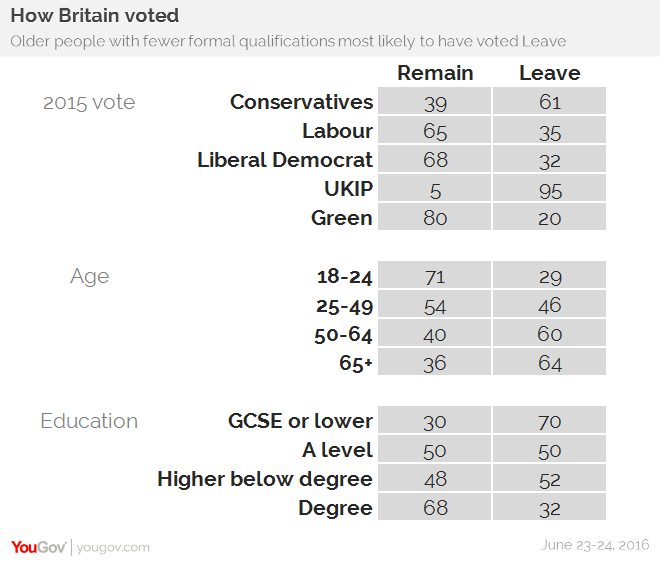
However,  Labour voters nationally voted by 65% to Remain in the EU as this YouGov poll showed (despite being in the 50-64 age group my husband and I both voted Remain!)


The results show that 51.89% of all those who voted vote Leave


and as that is a simple majority it would appear to be the democratic thing to abide by it, hence the official Labour Party stance. So it does give a huge problem for Labour MPs who have to balance the will of their local electorate as against the will of the national electorate and the will of Labour supporters and voters generally.

Which brings us to the other big problem: England and Wales voted to leave, Scotland and Northern Ireland didn't, so how will BREXIT for the United Kingdom manage that, and will the UK itself survive BREXIT or will it result is the break up of the union?


All of this totally ignores the fact that the Referendum as created by the European Union Referendum Act 2015 was an ADVISORY one not a MANDATORY one, so should have been treated as an Opinion Poll to lead onto further negotiation, rather than a clear instruction to leave the EU, and you then end up with the almighty mess we currently have!