Showing posts with label EU. Show all posts

Wednesday, 15 March 2017

Canned 'Kippers

Last month as part of the OpenMedia campaign against the so-called Link Tax, or more properly the European Commission’s proposal on Copyright in the Digital Single Market Directive, I emailed the MEPs who represent my area (i.e. the North West of England) raising concerns about how the Directive would adversely impact on a whole host of internet users from bloggers like me to new internet-based businesses and would ride rough-shod over existing rights across the whole of the Internet.

My email was as follows:
Sent: Thursday 23 February 2017 03:56
Subject: Save the Link: No #linktax or mandatory censorship
Dear Member of the European Parliament,
I am writing to express my concern about the Commission’s proposal on Copyright in the Digital Single Market Directive, announced on September 14.
I am worried about the proposals in Article 11 and 13 which amount to a link tax, and mandatory censorship.
The “Link Tax” proposal creates a new ancillary copyright for press publishers. This new right would create unprecedented new monopolies for publishing giants to charge fees for snippets of text that automatically accompany hyperlinks.
The Link Tax will act as a brake to innovative EU digital startups that will never be able to get off the ground if forced to pay these fees. This proposal has failed everywhere it has been previously tried, including Germany and Spain.
I draw your attention to a briefing on this issue produced by the Save The Link campaign (https://SaveTheLink.org), which I support. You can download the briefing here: https://openmedia.org/sites/default/files/documents/mepbriefing-singlepgsinteractive_0.pdf
I am also very concerned about the new proposal for content filtering and increased liability of Internet companies. The proposal at Article 13 includes requirements for monitoring Internet users, demanding that tech companies produce filtering robots to detect the copyright status of user-generated content. This filtering would not be done on the basis on what is legal, but on whether uploads contain content that has been "identified" by rightsholders. This would overturn existing rights for quotation, parody and other public-interest copyright exceptions.
The European Commission pushed this idea forward despite overwhelming opposition in its consultation from over 120,000 Internet users and dozens of civil society groups.
The Commission has failed to defend the interests of citizens – we need you to stand up and act as our voice.
We ask you to pay close attention to Article 11 which proposes an ancillary copyright for press publishers as well as Article 13 and recitals 38 and 39 which propose mandated content filtering technologies.
Please, stand up for my rights and challenge these proposals which will seriously harm the Internet, and the citizens you represent.
I look forward to hearing your response.
In the North West there are eight MEPs: 3 Labour, 1 LibDem, 1 Tory, and 3 UKIP.  To date I have had a reply from just one MEP, UKIP's Paul Nuttall (the man who failed to gain the Stoke on Trent seat for UKIP in the recent parliamentary by-election).  His response was risible:
Copyright in the Digital Single Market Directive
Now we are leaving the European Union we will not be bound by their rules, it will be up to member states to decide such legislation for themselves.
Fortunately, once we have left the EU we can again decide our own legislation, via our democratically elected U.K. Parliament.
Thus, even if the EU Parliament votes through this Directive, we can later chose to delete it from our Statutes.
Apart from not even having the courtesy of a personalised response - what I have copied above is exactly what was in his emailed reply - it appears to be the sort of basic stock response that any UKIP MEP might send out to any query about any piece of EU legislation. 

A British MEP's final take-home pay (which varies from month to month based on the exchange rate) is roughly £3,900 per month, a sum for which I expect a darn-sight better response than a canned "when we leave the EU all will be well"! 

Friday, 27 January 2017

BREXIT this and BREXIT that.... why are MPs resigning from the Shadow Cabinet again?

I have no love for BREXIT, as readers of this blog will know. The whole 2015 EU Referendum thing was so badly thought out last year, and David Cameron should be called to account for his actions.

Over the last 24 hours members of the Shadow team have resigned, citing concerns over Article 50 and a three-line Whip imposed on Labour MPs, triggering fears of a repeat of last year's wholesale ship-jumping by MPs intent on discrediting Jeremy Corbyn's leadership of the Labour Party.

The Labour Party is caught in a difficult position over the BREXIT vote.  Tory MPs are overwhelmingly (bar one so far) in favour of triggering Article 50, whilst the LibDems (all 9 of them), the sole Green MP and the SNP are all against it.  Labour however has the dichotomy of having MPs representing the highest vote Remain areas and the highest vote Leave areas, so any Labour MP where the Remain vote carried has a duty to their electorate to reflect the wishes of their constituents. Hence the rebellion against the party Whip. For those MPs where the Leave vote carried but who campaigned for Remain there is the problem of which way to vote on the Bill.


But, as Chris Hanretty blogged, not all voting areas reflected whole constituencies, so it is not possible to tell how every constituency voted. Some areas cover multiple whole or part constituencies, so how do you apportion voter intent to a constituency there?

In my own (Westmorland & Lonsdale - the big yellow area in the north-west of England on the map represented by LibDem leader Tim Farron) it was a clear Remain vote, one of the few Remainer areas in England outside of London and the South-East. Looking at the map gives a better picture of which areas voted Remain and which voted Leave.


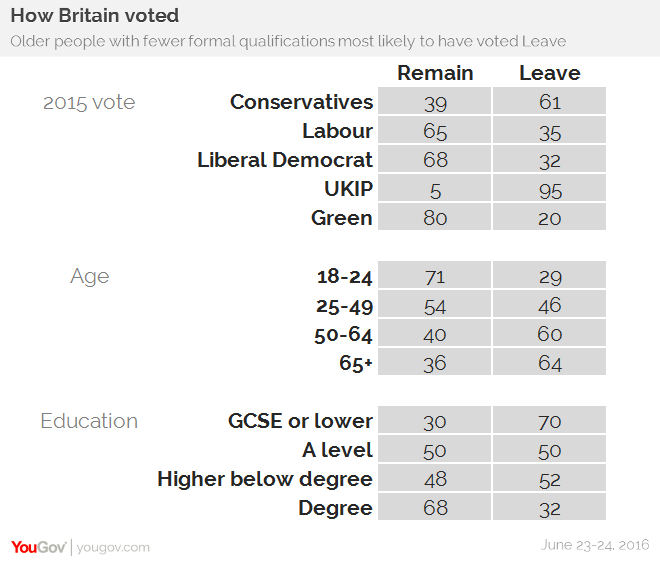
However,  Labour voters nationally voted by 65% to Remain in the EU as this YouGov poll showed (despite being in the 50-64 age group my husband and I both voted Remain!)


The results show that 51.89% of all those who voted vote Leave


and as that is a simple majority it would appear to be the democratic thing to abide by it, hence the official Labour Party stance. So it does give a huge problem for Labour MPs who have to balance the will of their local electorate as against the will of the national electorate and the will of Labour supporters and voters generally.

Which brings us to the other big problem: England and Wales voted to leave, Scotland and Northern Ireland didn't, so how will BREXIT for the United Kingdom manage that, and will the UK itself survive BREXIT or will it result is the break up of the union?


All of this totally ignores the fact that the Referendum as created by the European Union Referendum Act 2015 was an ADVISORY one not a MANDATORY one, so should have been treated as an Opinion Poll to lead onto further negotiation, rather than a clear instruction to leave the EU, and you then end up with the almighty mess we currently have!


Monday, 20 June 2016

EU Referendum: If you only watch one video please make it this one!

It's only a couple more days until the EU Referendum on our membership of the EU. You're probably sick of all the rhetoric, arguments for and against by now. But I would urge anyone reading this blog, if you only watch one video please make it this one!

Friday, 10 June 2016

A vote to LEAVE the EU in the Referendum will not solve the EU VATMOSS issue!

You might recall that I was particularly vocal about the #EU #VATMOSS issue last year... if not then a look back through the blog will fill you in on what I was saying...  but as we approach the EU #Referendum. it's worth flagging up how the REMAIN / LEAVE votes relate to the issue of VAT on cross-border digital sales within the EU.

You might think that if we vote LEAVE then all our woes will end and VATMOSS will no longer be an issue for micro-businesses...   and you would be wrong!

In fact, a vote to LEAVE would make the situation even worse for small traders... 

Clare Josa (co-founder of the EU VAT Action Campaign and one of the team which took up the issue of how VAT on digital cross-border sales was hurting small businesses) explains why...

http://www.dancinginyoursoulshoes.com/will-happen-eu-digital-vat-leave-eu-10-popular-myths-debunked/


Four possible legal outcomes of Brexit

The EU Referendum is too important an issue for how to vote to be decided by silly TV debate name-calling, by incorrect info on leaflets or the side of a campaign bus, by biased media reportage, by chats with your mates down the pub. 

What is really needed is some actual factual information on what the outcome will mean for you, for me, for our kids and grand-kids, our communities, our workplaces and our public services.

This is one of the most succinct summaries that I have seen so far...

"EU Referendum: Know the facts: Square One Law guide lays out four possible legal outcomes of Brexit"


Tuesday, 7 June 2016

‪#‎EU‬ MythBusters: "The EU forces its will on member countries"

Not true.

Nothing is decided at EU level unless all member countries have explicitly agreed by treaty to do so, and even then each piece of legislation is agreed by national governments. For sensitive matters like tax and foreign affairs, the requirement for this agreement is complete unanimity, and in other areas there is a very high "qualified majority" threshold. (A "qualified majority" is defined as: 55% of member states, representing at least 65% of the EU population)

This means that no one state (or minority of states) can impose a measure on other member states, and that smaller states cannot override states with larger populations.


‪#‎EU‬ MythBusters: "EU membership costs us a fortune"

Traditionally, the UK net contributions to the EU budget are less than 1% of UK’s public spending. While all bigger and richer member states are net contributors, as a contribution per capita the UK is behind countries like Germany, Sweden, the Netherlands or Austria, Finland and Belgium.

The Confederation of British Industry estimates that EU membership is worth £3,000 a year to every British family — a return of nearly £10 for each £1 we pay in. And the budget for the whole EU is just 1% of GDP, compared to about 49% spent by national governments. That’s just 2% of our public spending each year.  http://www.richardcorbett.org.uk/eu-membership-costs-us-a-fortune/


This is a useful reminder of how much (or more aptly how little) our membership of the EU costs each taxpayer per day... just 11.8 pence per taxpayer per day (or £43.07 per year) which when compared with the CBI's own assessment that EU membership is worth (that is, brings a return value back) to each family of £3,000 per year makes the Leave argument on the grounds that it costs too much a total nonsense. 


What does the ‪#‎EU‬ do for us? Protects against sexual discrimination in the supply of goods & services...

The Gender Directive, officially Council Directive 2004/113/EC of 13 December 2004 implementing the principle of equal treatment between men and women in the access to and supply of goods and services, is a directive which prohibits both direct and indirect sexual discrimination in the provision of goods and services in the European Union.

The directive applies to:
  • all people and organisations (both public and private sector) that make goods and services available to the public;
  • goods and services offered outside the area of private and family life.

National equality bodies
Each EU country must have at least one body responsible for promoting equal treatment between women and men in the fields covered by the directive. These national equality bodies are empowered to analyse the problems encountered, monitor the situation in their country, make recommendations and provide concrete assistance to victims.

Preventing insurers from using gender as a risk factor
According to Article 5(1) of Directive 2004/113/EC, member states must ensure that "the use of sex as a factor in the calculation of premiums and benefits for the purposes of insurance and related financial services shall not result in differences in individuals' premiums and benefits".


Monday, 6 June 2016

‪#‎EU‬ MythBusters: "Most of our laws come from Brussels"

Not true.

The independent House of Commons library found that the real proportion is just 13.2% of our laws. And these figures include everything that even mentions the EU, even if it's just a passing reference or a definition, according to the researchers!

Broken down this means 1.4% of our Acts of Parliament and 12.9% of implementing measures (Implementing Measures are mandatory requirements in the form of regulations which come into force without further implementation into national laws.)

Hardly overwhelming, is it? http://www.richardcorbett.org.uk/laws-from-brussels/


What does the ‪#‎EU‬ do for us? Protects birds...

The Birds Directive (formally known as Council Directive 2009/147/EC on the conservation of wild birds) is a European Union directive adopted in 2009. It replaces Council Directive 79/409/EEC of 2 April 1979 on the conservation of wild birds which was modified several times and had become very unclear. 


It aims to protect all European wild birds and the habitats of listed species, in particular through the designation of Special Protection Areas (often known by the acronym SPA). Europe is home to more than 500 wild bird species, but at least 32% of the EU's bird species are currently not in a good conservation status. The Birds Directive aims to protect all of the 500 wild bird species naturally occurring in the European Union.

The Birds Directive is one of the EU's two directives in relation to wildlife and nature conservation, the other being the Habitats Directive (see last blog post).  The Habitats Directive led to the setting up of a network of Special Areas of Conservation, which together with the existing Special Protection Areas form a network of protected sites across the European Union called Natura 2000.


What does the ‪#‎EU‬ do for us? Protects wildlife and habitats...

European Protected Species (EPS) are species of plants and animals (other than birds) protected by law throughout the European Union. They are listed in Annexes II and IV of the European Habitats Directive.

The lists include several hundred species of plants and animals. They do not include any fungi, lichens or birds.

European Union states are required under the Habitats Directive to protect the listed species, and for some species (those listed in Annexe II), they are required to designate Special Areas of Conservation (SACs) to protect populations of them.

These regulations help to protect areas of land from development which will harm or destroy those species... without this protection developers will be free to ride roughshod over any land irrespective of what it contains.


Sunday, 5 June 2016

What has the EU ever done for my … town?

Good question!

Projects across the UK, from getting people into work to building new tram stops and museums, have gone ahead with EU cash.

Areas of deprivation have benefited from funds from the EU. Areas which have been flooded have been helped by payments from the EU flood fund. Arts funding and business development grants, funds to help workers made redundant or those who live in areas of high unemployment, money to help build or rebuild infrastructures at the heart of our communities, and much more besides... all has come from the EU.

If the UK votes to leave the EU on June 23rd then we will lose access to these funds. Some folks claim that the UK government will fill the need from the savings made from the EU contribution, but many of us are unconvinced. The government has no track record of supporting many of these issues, nor of allowing such spending.

In the end it will be us and our communities which lose out by leaving the EU.

Vote REMAIN on June 23rd to make sure we don't end up as the poor relation on the edge of Europe.


Thursday, 22 October 2015

Does the Labour Campaign for the Self Employed give us a glimmer of hope?

The creation of the Labour Campaign for the Self Employed has given hope to many sole traders and micro-businesses that their concerns may at last find a champion. I am hoping that the Campaign will address the issues that face us in respect of VAT changes affecting digital cross-border sales. This is the message I have sent to the campaign today: 

The imposition of impossible EU regulations such as the VAT scheme for digital cross-border sales that came in on 1st Jan 2015 is a problem for us. It is impossible to comply with in many cases and is putting sole traders and micro-businesses at a huge disadvantage and driving trade back to the big guys like Amazon, as the smaller traders simply cannot meet the requirements of the rules at any price!

The EU has accepted that small traders being hurt was an unforseen and unintended consequence of the new rules, and that it was never the EU's plan to affect us, as according to the EU they simply did not know that we would be affected at all. The assumption appears to have been, "Don't you all sell via Amazon or eBay anyhow?" - No we do not!

For any sole trader or micro-business that sells cross-border digital products directly from its own website the initial costs of the changes required to the website are anything up to £4,000 to make the website capable of collecting the proof needed, and even then we cannot guarantee the data that we have to collect from the buyer.

The change was intended to prevent the big guys like Amazon and eBay from routing their sales via the country with the lowest VAT rate (i.e. Luxemburg mainly).  The irony is that the new rules are forcing many of us to sell via the big guys now as they can meet the new rules, whereas we cannot.

Whilst previously we would have had to charge VAT on digital cross border sales at the UK rate only if our turnover exceeded the £81,000 VAT threshold for domestic sales, now we have to charge VAT at the rate in the buyer's country and there is no threshold for digital cross-border sales, so even if we sell a music mp3 or an ebook or a knitting pattern for less than a £1 we have to register under the scheme and collect the VAT and pay it on to the buyer's tax authority.

To do so we have to *prove* where the buyer is based and calculate the VAT rate for that country and charge the buyer the relevant rate for the goods purchased (one of 70+ rates in 28 countries), and then remit the VAT to that country either directly or via one of the MOSS schemes that has been set up by different country tax authorities.

The proof we can accept includes an IP address, but this is not reliable evidence of geographical location in many cases and can be spoofed by buyers or reported incorrectly depending on how the buyer is connecting to the website to buy.

The UK government could unilaterally suspend the new rules until the EU gets the issue sorted and brings in the promised small turnover threshold but despite being asked to do so it has not. The threshold could take a couple of years to arrive as it has to be discussed and agreed by all EU member states, meanwhile we are struggling with trying to comply, or we can simply refuse to sell outside the UK (which also falls foul of another EU requirement about free trade across the EU!)

Meanwhile, you can keep up to date with progress of the threshold over on the website of the EU VAT ACTION CAMPAIGN


Sunday, 20 September 2015

In or out? The EU I mean...

Last night saw us forsaking the BBC's new series of Dr Who and heading northward to the Marchesi Centre in Windermere where Julie Ward, MEP, was to address a public meeting organised by the Westmorland and Lonsdale Constituency Labour Party.

It was perhaps optimistic to expect a large turnout on a Saturday night but, although few in number, we made up for that in interest and enthusiasm, and were joined by four visitors from the Fylde who had travelled some 45 miles to attend the meeting.

Julie, who is a fairly new member of the European Parliament - elected in May 2014, is one of eight MEPs that represent the North West Region - three of whom are members of the European Parliamentary Labour Party. Her particular interests include culture, education, children, and gender equality and she is an active campaigner for equal rights and social justice.

A broad-brush explanation of how the EU works set the scene for us, with lots of detail about the political groups which operate in the EU (instead of along party lines as in the UK parliament), and how much of their work is carried out in the 20 committees that each cover a specific area of interest or policy making. She gave examples of how her own work on Committees has affected and improved the lives of individuals and groups, and described the impressive translation system which can service members from the 28 different nations in the EU simultaneously.

A lively question and answer session followed, covering issues such as the Greek financial crisis, the planned TTIP (Transatlantic Trade and Investment Partnership) deal, and this year's changes to the way VAT is collected on digital cross-border sales and its impact on low turnover businesses and sole traders.

One of the things I came away with was a much better understanding of how the UK benefits from its membership of the EU, and how much we stand to lose if we leave it.  From legal protections to jobs, much will be undermined or removed if we opt out of Europe in the Government's planned referendum.