Showing posts with label Brexit. Show all posts

Sunday, 3 December 2017

Voting... why bother?

If you don't vote in elections because you feel that your vote won't make a difference, please think again!

In the 2017 General Election (GE) some 12,878,460 people (40% of the vote) supported Labour candidates, whilst the Conservatives gained 13,669,883 votes - just 791,423 more than did Labour - which, due to the FPPT voting system in the UK, resulted in 55 more Tory MPs (317) than Labour MPs (262).

Stats chart by Awake the Dragon

Interestingly, at least for numbers geeks like me, if you divide the total number of votes for each of the two main parties by the number of MPs elected for each of the two main parties this is the result:
  • Tory 13,669,883 votes / 317 seats = 43,122 average votes per elected MP
  • Labour 12,878,460 votes / 262 seats = 49,154 average votes per elected MP
So, nationally, it could be said that each Labour MP speaks for more Labour voters than does each Tory MP for Tory voters!

However, the turnout for the 2017 GE was 32,203,481 voters, equating to 68.8% of the registered electorate of 46,807,385. This means that 14,603,904 people on the electoral register did not vote. That non-voting figure is larger than the number of voters who voted for either the Tory or the Labour party, so those votes can and would make a difference.  Add onto that the number of people eligible to vote but who are not on the electoral register, which is thought to be around a further 4 million people, and you see a different picture of voter power.

Stats chart by Awake the Dragon

What conclusion might we draw from the figures above? Clearly, that governments are elected not by a majority of the voting age population, but by a majority of the population who bothers to vote. For those who say that voting changes nothing, the figures would indicate otherwise, as if the 20 million people who were eligible to vote on 8th June 2017 had done so, the country might not be enduring yet another austerity driven government benefiting the privileged few and causing hardship and harm to many. The message really is, "EVERY VOTE COUNTS!"

To make sure that you have and keep your eligibility to vote at future elections, please make sure you are on the electoral register. See here for how: https://www.gov.uk/browse/citizenship/voting - don't put it off. There is supposed to be a fixed five year term between General Elections but, as we saw in June 2017, things can change resulting in an early GE, especially with the uncertainty of the DUP continuing to prop up the Tory government if the Irish border / BREXIT issue causes a rift.

Monday, 5 June 2017

This extraordinary general election

We are approaching what is probably the most important election of our lifetimes, so it saddens me immensely when I hear voters say they don't want to hear about election issues, or that they have no interest in politics, whilst political decisions affect every aspect of their lives from birth to death and all the bits in between.

Part of the cause of that lack of interest or apathy or whatever it is, I feel, is down to the behaviour of a large number of politicians of all parties over several decades, who have shown that there is no real difference between them, who have all jumped onto the Westminster gravy train and exploited the system for themselves. Whether that was the expenses scandal, or flipping homes to benefit from offsets, or heavily subsidised catering and drinks in the Houses of Parliament, or lucrative consultancy positions with businesses seeking to influence government, or a comfy seat on a corporate board on standing down from politics, or even an elevation into the upper chamber with a life peerage: all of these have made politicians toxic in the eyes of many voters.

What we have now are several parties which appear to still be operating on that same basis, and one (Labour) which has a change of leader and which is actually proposing a different path for the country. There is still work to do to make changes within the "political class", but I think this is the first chance we as voters have had since 1945 to really call our elected representatives to account and make significant improvements to life for ordinary people.

If you look at the proposals being put forward by both of the two major parties, one set is driven by austerity and privatisation, the other is driven by people and investment.  On Brexit, which seems to be the whole reason for us having yet another election anyhow, you will have a team of David Davis, Liam Fox and Boris Johnson for a Tory govt., or the superbly qualified Sir Kier Starmer QC, Emily Thornberry and Barry Gardiner for a Labour govt. It is not, as the PM keeps stating, going to be "me or Corbyn" doing those talks. I think that last year's Referendum result was a wake-up call for many people who have just ticked along, coping as we tend to do, getting by with some grumbles and our usual British stoicism.

The divisions caused by the close Referendum result, the realisation by younger people that their future has been changed irrevocably, and the fear that somehow we have released from a bottle a genie with malicious intent, seems to have activated the electorate in a way not seen by most of us before. That the cuts to our public services have been brutal is undeniable, that those cuts have impacted on how the safety and security of the country is managed is also undeniable, and that we have endured terror attacks in London and Manchester should be enough to shake us out of any complacency we feel about having a Tory govt. The cuts to police and security services over the last seven years have, in the words of retired and serving police officers, led to a position where they are no longer able to effectively do the job we expect of them and keep us safe. Those cuts are down to the decisions taken by the Tory govt, the Tory PM, and the Tory Home Secretary. It would have been very easy for people to be frightened into more of the same: the media expound constantly that the Tories are the party for strength and security, but voters are no longer being taken in by that rhetoric. The cuts since 2010, that have led to where we are now, were done by a Tory govt. and people know it, and are not happy with this situation. 

I have been a political activist all my life. I worked for two different trades unions and saw how working people were treated by a whole raft of different companies, large and small. I served on an Employment Appeal Tribunal for a while, sat on a trades council for a longer period, and worked with various groups and on various campaigns both as a member of the Labour Party and outside it. I left Labour under Kinnock as I didn't agree with the direction the party was going under him and Mandelson, and didn't feel able to rejoin under Blair's New Labour as the party inched further to the right under its neo-liberal policies such as PFI, although to give the Blair govt. credit they did actually do some good work in respect of families and children especially, but totally lost public credibility with the Iraq War.

From the late 1980's I was not party politically active until two years ago, when Jeremy Corbyn announced he was running for the party leadership and I rejoined Labour. I remembered his campaigning in London when I lived and worked there, his stance against apartheid and fighting against miscarriages of justice. He has never, in all his 30+ years as an MP, changed from being the highly principled and very honest man he was back then, and I have no reason to think he will change now.

But, you might say, he is just one man... and yes that's true, but he also has tremendous support within the party and (although the press would have you think otherwise) amongst Labour MPs. Also, in 2015 there were a number of newly elected Labour MPs who came from ordinary working backgrounds rather than being more privileged. They are people who had "proper jobs" before standing for election, not those who worked as special advisors (spads) to MPs, so they are more grounded, they relate to the lives and experiences of voters, and will help to bring about the changes we need to see.

All of this - despite the tragedies of recent weeks - has given me hope that we will see a change for the better. That people who have seen the cuts bite into public services, schools, police, health, etc. over the last seven years, have finally reached the point where they are saying, "ENOUGH!" and I hope they will vote for change, vote against more of the same Tory austerity, and will vote for a Labour government to put things right. 


Friday, 27 January 2017

BREXIT this and BREXIT that.... why are MPs resigning from the Shadow Cabinet again?

I have no love for BREXIT, as readers of this blog will know. The whole 2015 EU Referendum thing was so badly thought out last year, and David Cameron should be called to account for his actions.

Over the last 24 hours members of the Shadow team have resigned, citing concerns over Article 50 and a three-line Whip imposed on Labour MPs, triggering fears of a repeat of last year's wholesale ship-jumping by MPs intent on discrediting Jeremy Corbyn's leadership of the Labour Party.

The Labour Party is caught in a difficult position over the BREXIT vote.  Tory MPs are overwhelmingly (bar one so far) in favour of triggering Article 50, whilst the LibDems (all 9 of them), the sole Green MP and the SNP are all against it.  Labour however has the dichotomy of having MPs representing the highest vote Remain areas and the highest vote Leave areas, so any Labour MP where the Remain vote carried has a duty to their electorate to reflect the wishes of their constituents. Hence the rebellion against the party Whip. For those MPs where the Leave vote carried but who campaigned for Remain there is the problem of which way to vote on the Bill.


But, as Chris Hanretty blogged, not all voting areas reflected whole constituencies, so it is not possible to tell how every constituency voted. Some areas cover multiple whole or part constituencies, so how do you apportion voter intent to a constituency there?

In my own (Westmorland & Lonsdale - the big yellow area in the north-west of England on the map represented by LibDem leader Tim Farron) it was a clear Remain vote, one of the few Remainer areas in England outside of London and the South-East. Looking at the map gives a better picture of which areas voted Remain and which voted Leave.


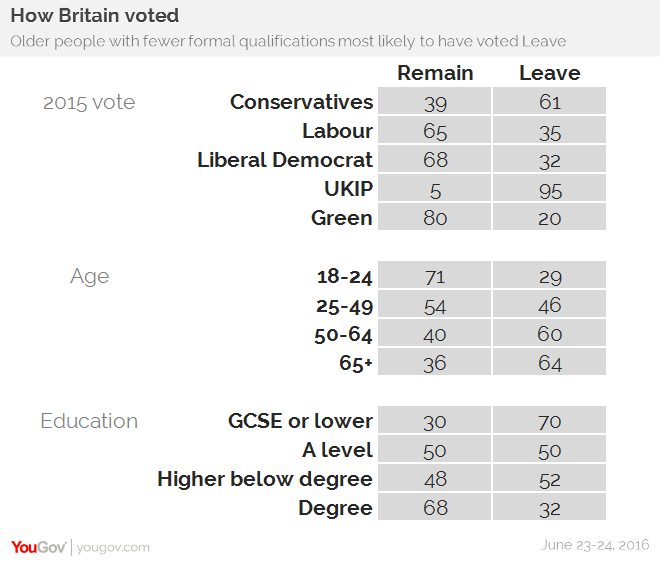
However,  Labour voters nationally voted by 65% to Remain in the EU as this YouGov poll showed (despite being in the 50-64 age group my husband and I both voted Remain!)


The results show that 51.89% of all those who voted vote Leave


and as that is a simple majority it would appear to be the democratic thing to abide by it, hence the official Labour Party stance. So it does give a huge problem for Labour MPs who have to balance the will of their local electorate as against the will of the national electorate and the will of Labour supporters and voters generally.

Which brings us to the other big problem: England and Wales voted to leave, Scotland and Northern Ireland didn't, so how will BREXIT for the United Kingdom manage that, and will the UK itself survive BREXIT or will it result is the break up of the union?


All of this totally ignores the fact that the Referendum as created by the European Union Referendum Act 2015 was an ADVISORY one not a MANDATORY one, so should have been treated as an Opinion Poll to lead onto further negotiation, rather than a clear instruction to leave the EU, and you then end up with the almighty mess we currently have!


Friday, 10 June 2016

Four possible legal outcomes of Brexit

The EU Referendum is too important an issue for how to vote to be decided by silly TV debate name-calling, by incorrect info on leaflets or the side of a campaign bus, by biased media reportage, by chats with your mates down the pub. 

What is really needed is some actual factual information on what the outcome will mean for you, for me, for our kids and grand-kids, our communities, our workplaces and our public services.

This is one of the most succinct summaries that I have seen so far...

"EU Referendum: Know the facts: Square One Law guide lays out four possible legal outcomes of Brexit"