Tuesday, 2 February 2021

R.I.P. Maureen Colquhoun, feminist, activist, inspirational woman

I am very sad to hear today of the demise of Maureen Colquhoun, a former Labour MP, ardent fighter for the rights of women, sex workers, gay people, and the first openly gay woman MP in the UK Parliament. 

Maureen Colquhoun, in August 2018, aged 90.

My hubby and I had the pleasure of meeting Maureen, at a birthday party given for her 90th in August 2018 by comrades from South Lakes Labour, along with her partner of many years Babs Todd (publisher of the lesbian magazine Sappho). 

Maureen (left), Babs (right) and Eli Aldridge (Labour candidate for Westmorland & Lonsdale at the 2017 General Election) at the party given for Maureen's 90th birthday. 

Maureen was an inspiration to many of us in the Labour Party, showing women that we didn't have to accept the status quo and that women have an equal right to be heard.

Maureen served as a councillor in Shoreham from 1971-1974, and was elected as the Labour MP for Northampton North from 1974-1979, when she was deselected by the constituency party due to her sexuality and her lesbian relationship with Babs becoming common knowledge. She later served on Hackney Borough Council (1982-1990), then on moving to Cumbria on the Lake District National Park Authority (1998-2006) and on the Lakes Parish Council until 2015. 

She was a radical voice in Parliament, requesting of the Speaker that she be addressed as MS rather than Mrs in the House, and raising the fact that during a debate in the House of Commons in 1975 on the Sex Equalities Bill not a single woman had been called to speak during an hour of debate. She also challenged the male assumed language of the Bill, which referred to he throughout, asking why it could not be s/he

To address the inequality that women faced she introduced a Private Members Bill (Balance of the Sexes Bill) aimed to enforce the equal representation of women in government positions and on public bodies. Although her Bill didn't pass into law, her work led to later changes in the law as more women, including Babs Todd, joined the campaign for equality of the sexes. 

It wasn't until the 2001 amendment to the 1975 Sex Discrimination Act that it finally became lawful for political parties to allow all women shortlists when selecting candidates for election, whilst it took until January 2018 for Members of the Scottish Parliament to pass a bill similar to hers:

"The Gender Representation on Public Boards (Scotland) Bill set the objective for all public body boards to aim to have women comprise a minimum of 50 per cent of nonexecutive members by 2022. Contemporary efforts in England and Wales have not manifested in legislation and have instead relied on a voluntary approach to ensuring equal gender representation on public boards." [Source: The Labour Party, Feminism and Maureen Colquhoun's Scandals in 1970s Britain / Sarah Crook]

Maureen believed that women "should be the legislators as well as the makers of cups of tea", and all of us women activists owe her a huge thank you for her pioneering work. 

You can read more about Maureen on the LSE website here:

Article on Labour List by Angela Eagle, M.P. (Wallasey):

New item from the BBC

The Labour Party, Feminism and Maureen Colquhoun's Scandals in 1970s Britain / Sarah Crook

or in Maureen's autobiography A Woman in the House


Monday, 8 June 2020

The Bristol statue that went for a dip

Feelings are running high around the world after the death of George Floyd in America at the hands of a white police officer in Minneapolis, nowhere more so than in Bristol, where a controversial statue of slave trader Edward Colston was dragged from its plinth and down to the harbour-side, where it was then pushed into the Bristol channel, to the delight of the assembled crowd.
In a BBC report the statue was described by Bristol mayor Marvin Rees as "an affront" to the city's community but that it would most likely be retrieved from the water and placed in a museum - hopefully with explanatory panels about the horrors faced by those who were taken into slavery by traders such as Colston in the 18th and very early 19th centuries.

The slave trade was mainly in the hands of the Portuguese, the Dutch, the French and the British. Slaves went to the New World, mostly to Brazil and the Caribbean. From 1660, the British government passed various acts and granted charters to enable companies to settle, administer and exploit British interests on the West Coast of Africa and to supply slaves to the American colonies.

Bristol was, of course, the major slave port in Britain and, along with London and Liverpool, much of their wealth came from philanthropists such as Edward Colston who made their fortunes from the slave trade before the final abolition of the slave trade by The Abolition of the Slave Trade Act in 1807.

As so many of our port cities were built as a result of the profits of slavery, and many of those will have statues or memorials to those traders whose fortunes helped develop them, so some commentators are arguing that we should be grateful to them for their philanthropy whilst ignoring the issue of slavery, whilst others (myself included) feel that these symbols of oppression should be removed.

Statue of Edward Colston in Bristol, image by Simon Cobb and used under the Creative Commons CC0 1.0 Universal Public Domain Dedication
In most places the names of slave traders will have passed out of memory, but in Bristol the Colston Society exists, and every year holds events and services to remind the city of how wonderful their man was, with no mention of his heinous crimes against humanity, no reminder of the thousands of slaves who died as a result of his trading, just a celebration of him as a city benefactor not as the man who, as recent research has confirmed, can be directly linked to the deaths in transit of at least 20,000 African slaves, including more than 3,000 children. It's no wonder that Bristol became a flash-point at the weekend, and understandable that protesters wanted to make the ultimate point by tearing down the statue of Edward Colston that so many found offensive.

Whether or not you agree with the tearing down of the statue*, it has opened up the public debate on historical slavery in a way that no amount of council discussions or school homework over the years has managed to do.

There are many such public memorials to slavers in places in the UK, as this country's wealth was built on the enslavement of the peoples of the colonies and the exploitation of its home population, in industries such as cotton, sugar, spices, rum, timber etc.  It's time to remove these commemorative symbols from our public places and relocate them into museums of slavery and population history, where the stories of the exploitation of the people can be shown in the context, both of their abuse of the people involved and the fabulous wealth that the traders generated for themselves.

The stories of those who were enslaved in the pursuit of profit must be told, whether stolen from their own lands by slavers or our own native population forced to work in often appalling conditions for little money, they are our history and our ancestors.

Glorification of the slave owners and traders is not appropriate in the 21st century, irrespective of how philanthropic those people may have been and, whilst we cannot change our country's history, we can and should learn from it. If that means changing the names of buildings, such as community centres, schools, streets etc, from those of slavers to something more appropriate then this should be done.

If government and local authorities do not take heed of what has happened in Bristol, or if they respond in an inappropriate way, then they are opening the door on mass public action by people across the country who feel their voices are not being heard.

It's a wake up call!

See also The list of monuments and memorials removed during the George Floyd protests.


Thursday, 1 August 2019

We need more housing and we're not getting enough!

George Clarke's Council Housing Scandal programme on Channel 4 is making waves, and so it should!

Before the 1979 Conservative government we had a plethora of council housing - owned by local authorities and leased to those who could not afford to buy their own homes. Then came along the Thatcher government and introduced the Right to Buy scheme, with enticements and discounts to encourage tenants to buy the house they had previously been renting. OK, you might think, so what, they will build more to replace them... but they didn't, and therein lies the problem!

The council houses that have been sold off were not replaced. The funds that their sale brought into local authorities which a sensible person might think should have been reinvested in housing were not allowed to be. Councils could not build more houses. This is a huge part of the reason for the housing crisis, it's why families are struggling in sub-standard expensive private rentals, or staying with relatives, and it's not good enough!

A bit of housing history...

Let's look at the origins of council housing as given on the Parliament.uk website:
The end of the First World War in 1918 created a huge demand for working-class housing in towns throughout Britain. In 1919, Parliament passed the ambitious Housing Act which promised government subsidies to help finance the construction of 500,000 houses within three years. As the economy rapidly weakened in the early 1920s, however, funding had to be cut, and only 213,000 homes were completed under the Act’s provisions.
The 1919 Act - often known as the ‘Addison Act’ after its author, Dr Christopher Addison, the Minister of Health - was nevertheless a highly significant step forward in housing provision. It made housing a national responsibility, and local authorities were given the task of developing new housing and rented accommodation where it was needed by working people.
Further Acts during the 1920s extended the duty of local councils to make housing available as a social service. The Housing Act of 1924 gave substantial grants to local authorities in response to the acute housing shortages of these years. A fresh Housing Act of 1930 obliged local councils to clear all remaining slum housing, and provided further subsidies to re-house inhabitants. This single Act led to the clearance of more slums than at any time previously, and the building of 700,000 new homes.
Under the provisions of the inter-war Housing Acts local councils built a total of 1.1 million homes.
Think of that, 1.1 million homes built by local councils between 1919 and 1939, which equated to 55,000 houses per year.

Then came WW2 and the huge destruction of housing in many cities and ports across the country.  The University of the West of England (Bristol)'s website on Domestic Architecture 1700 to 1960 explains what happened next:
At the end of the war, slums remained a problem in many large towns and cities and through enemy action 475,000 houses had been destroyed or made uninhabitable. In many towns and cities, temporary accommodation was provided by pre-fabricated houses. Altogether 156,000 prefabs were assembled using innovative materials such as steel and aluminium and proved a successful and popular house type. Although many well outlived their life expectancy, pre-fabs were only ever intended as a temporary measure and for the new post-war government the provision of new council housing was a top priority. Local authority house building resumed in 1946 and of the 2.5 million new houses and flats built up to 1957, 75% were local authority owned.
So, another 2.5 million houses and flats were built between 1945 and 1957 which equates to an average of more than 200,000 new homes per year. 

Even in the late 1950s there were still houses available to rent privately, but the growth of council housing estates created new communities in towns, cities and villages across the UK and some of the older rental stock was sold off at low prices in many places, e.g. Radcliffe in Lancashire, where my late parents bought their 2-up, 2-down terraced cottage for £500 from the Wilton Estate. It had been realised that decent safe modern homes were needed by families and councils built them.

How did it all go wrong? 

In 1979 the Conservatives won the General Election and one of the key note policies of the new government under PM Margaret Thatcher was the Right to Buy scheme
After Margaret Thatcher became Prime Minister in May 1979, the legislation to implement the Right to Buy was passed in the Housing Act 1980. Michael Heseltine, in his role as Secretary of State for the Environment, was in charge of implementing the legislation. Some 6,000,000 people were affected; about one in three actually purchased their housing unit. 
This meant that some 1.8 million council homes have been sold to tenants at a discount between the 3rd October 1980 and the end of 2015. For much of the time of those sales councils were not allowed to use the funds received from the sales to build new houses. It is only relatively recently that councils seem once again to be allowed to build houses, although most of these have been in conjunction with a housing association so are more properly social housing not council housing, as they are not managed by the councils themselves.

In 2016 a further change occurred, when the Housing and Planning Act 2016 extended the Right to Buy to housing association tenants. This potentially affected an additional 1.3 million households without addressing either the net housing shortage or the difficulties in building new homes faced by local authorities and housing associations.

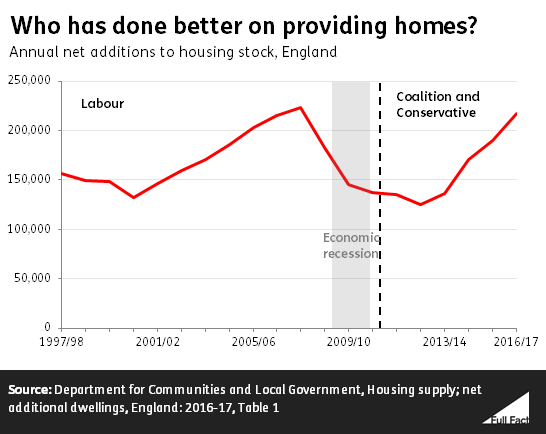
The fact verification website fullfact.org states:
Taking a long view, house building has been mostly decreasing since the 1960s. The early years of this decade saw house building at its lowest peacetime level since the 1920s.
No recent government has seen enough homes built to keep up with demand.
In 2014 Dr Alan Holmans, a housing expert at the University of Cambridge, produced new estimates of the housing gap. They were based on 2011 data but took housing conversions, second homes and vacancies into account.
His analysis suggests that we need to build about 170,000 additional private sector houses and 75,000 social sector houses each year—in total, an extra 240,000-250,000 houses each year, excluding any reductions in the existing housing stock.
So how many have been built and under which governments?


The graph doesn't give figures beyond 2016/17 but in November 2018 the charity Shelter stated:
At least 320,000 people are homeless in Britain, according to research by the housing charity Shelter.
This amounts to a year-on-year increase of 13,000, a 4% rise, despite government pledges to tackle the crisis. The estimate suggests that nationally one in 200 people are homeless. 
To provide homes for all the homeless will take political will, something which seems sadly lacking in this Tory government.

George Clarke's website states:
This year marks the 100th anniversary of the creation of council housing. But instead of being able to proudly celebrate its success we are sadly, firmly in the midst of a housing crisis.
Our country has not been building enough new council houses to meet demand. And since the 1980s, millions of council houses have been sold off through the Right to Buy without being replaced.
The result – more than 1 million people are on council house waiting lists today.
Is it any wonder that George Clarke is calling for 100,000 new council houses to be built every year for the next 30 years?

If you would like to add your name to his campaign petition please do!


Thursday, 17 January 2019

Great Excitement re Grange Lido!


What a week this is turning out to be for the Save Grange Lido campaign in which I got involved last May.  Not only has the group now achieved incorporation as a Cooperative Benefit Society, but it has also published its plans for how the restored Lido pool would look.

SGL Proposed Pool Restoration Plan at the Lido
Image: STUDIO OCTOPI/ PICTURE PLANE

The importance of these cannot be overstated, as next week the site's owners, South Lakeland District Council, will, at a meeting of its Cabinet, consider the site's future and decide whether or not to go ahead with their long-awaited plans or allow the SGL campaign to proceed with theirs.

SLDC Proposed Garden on the Lido Site

To remind you of the situation, a brief history of the site might be useful:  the Lido was designed and built by Grange Urban District Council in the 1930s as part of the then government's push for improved health and increased exercise for everyone.  It was constructed using labour from a scheme designed to provide work after WW1 (remember the 1930s was the start of the great depression) at a cost of around £18,000, and opened with a grand opening gala on 18th August 1932.

The Lido remained open and popular for 60 years but was then closed from 1993 after an alleged serious leak (although the pool still holds water - see first photo below) and an examination of council papers of the time revealed the closure was more to do with the need to make significant budget savings than the claimed leak itself.  Since 1993 the Lido site has been left to rot by its owners (the photos below were taken in June 2018).


So, the question is going to be, which is the better option?  A fancy garden which will cost ratepayers £1.9m plus annual upkeep, or a restored pool which will cost ratepayers nothing and will be self-financing.  I know which option I'd prefer!  #SaveGrangeLido

The Save Grange Lido Business Plan may be downloaded from here:
www.savegrangelido.co.uk
www.facebook.com/GrangeLido/
Twitter savegrangelido
Drawing credits: www.octopi.co.uk
See the abandoned pool from the air: Youtube

Monday, 27 August 2018

Lidos are good for people's health and well-being.


South Lakes Labour members recently voted to support the campaign call for the restoration of the currently derelict Grade 2 Listed Lido at Grange-over-Sands which LibDem controlled South Lakeland District Council has left to rot since they closed in in 1993. That this is a disgrace is incontestable, that the Lido could be restored for swimming with additional facilities is provable, and that it could therefore be a major attraction on Morecambe Bay is credible.

Outdoor swimming has become hugely popular and Lidos are seeing booming business across the country - Ponypridd Lido in Wales, which opened in March this year, has seen more than 64,000 visitors already (an average of more than 500 per day). Most Lidos were built in the 1920s and 1930s to help promote good health and well-being for working people, a role they can still perform today, along with boosting local economies, providing employment, supporting social inclusion and community, and attracting both day and longer stay visitors. A restored Grange Lido would become another really good reason to come to the Morecambe Bay area.


The campaign group Save Grange Lido has set up a petition calling on SLDC to abandon its planned infilling of the Lido with concrete (which would make it just a flat extension of the existing Promenade). It is known that people are willing to travel considerable distances to swim in Lidos, and Grange is the only remaining coastal Lido in the north of England. It would be a tragedy if it was destroyed. 

The petition is now approaching 10,000 signatures (currently 9417), and the target is to hit 10,000 ahead of the presentation to SLDC. There is also a paper version in many shops in Grange, and surrounding villages which so far has almost 500 signatures. A petition with more than 1,000 verified local signatures (i.e. those of people who live, work or study with the SLDC area) will be discussed at a full meeting of the Council.


With the coming of the Eden Project to Morecambe the focus will be on regenerating tourism in the whole bay area, to the benefit of communities both sides of the county border. If readers could please share the petition and encourage signatures that would be wonderful, the local signers guarantee the debate at Council, those from further afield demonstrate support for restoration of the Lido as a tourist attraction with a wider catchment area. Thank you.

https://www.change.org/p/south-lakeland-district-council-save-grange-lido

Saturday, 11 August 2018

Saving Grange Lido from council vandalism

I'm supporting the campaign to save the last surviving coastal Lido in the north of England from being filled in. Will you help me? Signing the petition will help send a strong message to SLDC that they are being shortsighted in disposing of this Grade 2 Listed Lido, which, although closed in 1993, could become one of the jewels of the South Lakes if restored and developed with creativity and ambition.

Monday, 23 April 2018

Labour’s tragedy is Britain’s tragedy, said The Spectator.

The headline is right, but not in the way that The Spectator article by Nick Cohen states. But then The Spectator is no friend of democratic socialism. Its articles seem to spend a lot of time bashing anyone politically on the left.

Britain's tragedy is the current Tory austerity government propped up by the DUP after being promised £1.5bn, following on from 5 years of Tory/LibDem austerity government that systematically slashed budgets nationally and to councils.

It is their insistence on massive "savings" which in reality meant local services being cut: police, fire, social care and health, public sector pay freezes that have led to health service workers and police officers having to apply for food help at food banks to feed their families.  In 2017 over 67,100 were identified as being lost due to government cuts since 2010. 

It is the increase in the use of zero hours contracts to avoid providing proper workers' rights and employment protection, sickness and holiday pay, and pensions. 

It is the atrocious treatment of sick and disabled people under the benefits system, so bad that even the UN has declared the UK govt to be at fault, its report said that UK legislation has “failed to recognise living independently and being included in the community as a human right,” citing cuts to social protection schemes related to housing and budgets for independent living.

It is the appalling news that 78 homeless people died on the streets and in temporary accommodation this winter, and that rough sleeping has increased by 169% nationally since 2010. "An estimated 4,751 people bedded down outside in 2017, but charities say the official statistics fail to capture the true level of street homelessness."

It is the current situation with the #Windrush generation and the government's attempts to create a “hostile environment” for illegal immigrants which has spilled over to encompass immigrants who are here legally and who were invited to come here after WW2 to help rebuild this country and who are now facing deportation due to the Home Office and govt. maladministration of their records. It is also having an impact on EU citizens who are living here, who have felt increasingly unwelcome after the BREXIT Referendum result in June 2016. 

So yes, Labour's tragedy is Britain's tragedy and the tragedy of everyone in Britain who is suffering under the current Tory government. The answer is #VoteLabour.


Friday, 20 April 2018

That's not democracy it's dictatorship!

In one of the recent FOCUS ON LOWER KENTDALE sheets from the LibDems that we are being deluged with in my area, there was a bit piece on the bottom of the front page that states there are "just 777 votes in it!"
I'd like to point out to the LibDems that this isn't a General Election and that Tim Farron is not going to lose his MP seat on May 3rd, so the size of his majority is not an issue at all, it's just scaremongering and distraction!

On May 3rd we are going to the polls to elect new SLDC councillors. 

Currently 31 of the 51 SLDC councillors are LibDems. They have an absolute majority and can thus do as they please with no-one and no group able to stop them. That's not democracy it's dictatorship!

This is the current breakdown of councillors on SLDC:

You can see that currently even if the Tories, Labour and the Indie all join forces they still cannot prevent the LibDems doing anything!

All councils and all governments work better with an effective opposition. 

We need more Labour councillors on the district council: to give a balance, to provide checks on decision-making, and to be a voice for the people.

Labour are standing candidates in every SLDC ward in Westmorland & Lonsdale. Even if you usually just vote for LibDem or Tory as the two dominant parties, why not this year opt for a Labour candidate?  Most wards have three seats, so having one Labour candidate in a ward isn't going to bring the end of the world, but it will bring the start of a more democratic council

Please think about it on May 3rd.

Tories and LibDems together in government from 2010-15, and Tories alone since then, have been responsible for the biggest cuts to local services in my lifetime, and I suspect yours too. Do you really want to see more cutbacks in services, more money wasted on frivolous projects, more decisions taken by one dominant party, or would you rather have a round-the-table, common-sense, representational approach from your local council? 

It's in YOUR hands!


See also the South Lakes Labour news page here: https://www.southlakeslabour.org.uk/blog

Wednesday, 4 April 2018

Is the UK Government Playing Russian Roulette?

I've been following the reports of the poisoning of two Russian nationals in Salisbury closely, as I suspect many others have. There seems to me to be some genuinely puzzling contradictions which need to be answered, but no-one from Government is answering them. The media seems focused on the Foreign Sec doing his war dance and shaking sticks at Russia and the fact that Jeremy Corbyn and a few others have requested evidence before making accusations against another nation (how very dare he?!)

Meanwhile, Craig Murray, a former British Ambassador to Uzbekistan (who was sacked for criticising Uzbekistan's human rights record, and for objecting to MI6's use of intelligence from the Uzbek torture chambers), has constantly maintained that the FCO officials he still has contacts with had told him there is no evidence that, whatever the substance is, it originated from Russia.


In a post on his own blog dated 20th March 2018, Craig said,
"I cannot in fact conceive of a more outlandish conspiracy theory than that the Russian government secretly manufactured and stockpiled novichoks, hidden from the OPCW, and secretly trained assassins, only to blow the whole operation on a retired spy they let out of jail ages ago."
The media has kept us updated with the "fact" that the nerve agent used was "of Russian origin", despite the destruction of the last of Russia’s stockpiles of chemical weapons being recorded in November 2017.
"Gen Ahmet Üzümcü, the director general of the Organisation for the Prohibition of Chemical Weapons (OPCW), which works closely with the UN, was fulsome in his praise. “This is a major achievement,” he said. The 192-member body had seemingly overseen and verified the destruction of Russia’s entire stock of chemical weapons, all 39,967 metric tons." 
Earlier today, Rob Merrick, the Deputy Political Editor of the Independent, wrote in his article,
"In fact, as the Porton Down chief executive acknowledged on Tuesday, the centre had been unable to determine if the novichok had been produced in Russia." 
We are also told by various sources, including Gary Aitkenhead, the current head of the Porton Down lab, that it is not possible to determine where a batch of novichok is made, and that it is a nerve agent to which there is no known antidote...
"Speaking to Sky News, Aitkenhead said it was not possible for scientists alone to say precisely where the novichok had been created."  ... 
"Aitkenhead said: “We were able to identify it as novichok, to identify it was a military-grade nerve agent. We have not verified the precise source,"  ... 
"He also said there was no known antidote to novichok but said Porton Down had advised Salisbury district hospital on how to treat the Skripals."
That the British Police Sergeant who was admitted to hospital affected by it has now recovered and been released from hospital, that Yulia Skripal is making a good recovery in hospital and is able to speak, yet her father is still incapacitated by the same substance seems puzzling: why would 2 out of 3 people affected by the same substance recover so quickly, yet the 3rd remain so ill?

To raise further questions, today the Russian Embassy has released the following press statement on their website:
"Embassy press officer answers question on Skripal case 
Question: The head of the Porton Down military laboratory, Gary Aitkenhead, has told Sky News that there is no antidote to negate the effects of the substance he calls “Novichok”. On the other hand, it is reported that Yulia Skripal who, according to British official statements, was poisoned by that substance, is recovering. Is there an inconsistency here?
Answer: Indeed, we note discrepancies between various British statements. That’s why we have sought clarifications from the Foreign Office, together with samples of the substance used, something that has been refused. Our questions on treatment methods used by the medics remain unanswered. In other words, we have no opportunity to directly verify whether the British have correctly identified the substance, nor whether they are correctly treating our nationals. Among other things, it remains unclear why Sgt Bailey has recovered, Yulia Skripal is recovering (if one is to believe it) while Sergei Skripal remains unconscious.
By the way, in the same interview Mr Aitkenhead said that Porton Down experts had consulted the medics on the course of treatment. We would like to know what recommendations they gave.
We have sent another diplomatic note to the Foreign Office on this matter."
So, what is the truth? Is a deadly nerve agent responsible for the hospitalisation of these people? If it is, is there an antidote, and if so why doesn't the head of the Porton Down lab know about it? If it's not a nerve agent, then what is it? Who administered it and why? And why is the UK government so insistent it is all down to the Russians when the evidence does not yet appear to support that claim?

Meanwhile, the Labour Party has 
"... called on the prime minister to launch an investigation into whether Mr Johnson broke the ministerial code."
"Shadow Cabinet Office minister, Jon Trickett, said Mr Johnson had "serious questions to answer"."
Like many others, I'm keenly interested in answers to those questions!

Sunday, 3 December 2017

Voting... why bother?

If you don't vote in elections because you feel that your vote won't make a difference, please think again!

In the 2017 General Election (GE) some 12,878,460 people (40% of the vote) supported Labour candidates, whilst the Conservatives gained 13,669,883 votes - just 791,423 more than did Labour - which, due to the FPPT voting system in the UK, resulted in 55 more Tory MPs (317) than Labour MPs (262).

Stats chart by Awake the Dragon

Interestingly, at least for numbers geeks like me, if you divide the total number of votes for each of the two main parties by the number of MPs elected for each of the two main parties this is the result:
  • Tory 13,669,883 votes / 317 seats = 43,122 average votes per elected MP
  • Labour 12,878,460 votes / 262 seats = 49,154 average votes per elected MP
So, nationally, it could be said that each Labour MP speaks for more Labour voters than does each Tory MP for Tory voters!

However, the turnout for the 2017 GE was 32,203,481 voters, equating to 68.8% of the registered electorate of 46,807,385. This means that 14,603,904 people on the electoral register did not vote. That non-voting figure is larger than the number of voters who voted for either the Tory or the Labour party, so those votes can and would make a difference.  Add onto that the number of people eligible to vote but who are not on the electoral register, which is thought to be around a further 4 million people, and you see a different picture of voter power.

Stats chart by Awake the Dragon

What conclusion might we draw from the figures above? Clearly, that governments are elected not by a majority of the voting age population, but by a majority of the population who bothers to vote. For those who say that voting changes nothing, the figures would indicate otherwise, as if the 20 million people who were eligible to vote on 8th June 2017 had done so, the country might not be enduring yet another austerity driven government benefiting the privileged few and causing hardship and harm to many. The message really is, "EVERY VOTE COUNTS!"

To make sure that you have and keep your eligibility to vote at future elections, please make sure you are on the electoral register. See here for how: https://www.gov.uk/browse/citizenship/voting - don't put it off. There is supposed to be a fixed five year term between General Elections but, as we saw in June 2017, things can change resulting in an early GE, especially with the uncertainty of the DUP continuing to prop up the Tory government if the Irish border / BREXIT issue causes a rift.

Sunday, 22 October 2017

Votes at 16 debate in Parliament

According to a report on Labour List, by Young Labour activist Leigh Drennan, on 3rd November Parliament will debate, and vote on, a proposal to extend the right to vote to 16 and 17 year olds. The proposal for Votes at 16 is supported by the Labour Party, the Green Party, the Liberal Democrats, and the SNP in their manifestos, but is opposed by the Conservatives and UKIP. 

Just a week later the UK Youth Parliament will sit in the House of Commons, when
Members of Youth Parliament aged 11-18 take part in an annual debate in the House of Commons chamber, chaired by the Speaker of the House of Commons Rt Hon John Bercow MP. They debate five issues chosen by a ballot of young people from across the UK and then vote to decide which two issues should become the UK Youth Parliament’s priority campaigns for the year ahead.
I find it rather ironic that young people from the age of 11 can take part in this, yet are told they cannot vote in Elections or Referendums until the age of 18!

Since May 2016 in Scotland people aged 16+ have been able to vote in Holyrood and local elections, but voting in General Elections and Referendums has been denied to them. 

One of the most frequently heard arguments against Votes at 16 is that 16 and 17 year olds have no clue about life or politics, so giving them the vote is a waste. This is nonsense, as shown by the quote from The Electoral Reform Society, which states, 
Since 2000, Personal, Social, Health and Citizenship Education (PSHCE) has been part of the National Curriculum. PSHCE established three overarching topics to teach students about life outside education: health and well-being, relationships, and living in the wider world. These core themes equip young citizens with knowledge that is found nowhere else in the curriculum. Together they provide young people with the first steps of a political education.
A report on the UK Parliament website states that
Those who support the extension of the franchise contend that citizenship education has made 16 and 17-year-olds more politically aware; that voting at a younger age can create a basis for political engagement later in life; and that there is an inconsistency between denying 16 and 17-year-olds a vote, but legally allowing them to take on other responsible social roles and duties. 
The debate and vote in November is an opportunity to extend the franchise to the more 1.5 million 16 and 17 year olds (representing around 2.4% of the total population) who are currently denied the right to vote and thus allow them to have a say in their future, but they are, however, allowed by law to:
  • Give full consent to medical treatment
  • Leave school and enter work or training
  • Pay income tax and National Insurance
  • Become a member of a trade union or a co-operative society
  • Obtain tax credits and welfare benefits in their own right
  • Consent to sexual relationships
  • Get married or enter a civil partnership, with parental consent
  • Change their name by deed poll
  • Become a director of a company
  • Serve in the armed forces but not deployed on the front line
  • Ride a moped
  • Apply for a provisional licence at 16 and drive a car on the road at 17
  • Buy a Lotto ticket
Surely if they are old enough to contribute to society through work, taxes, the armed forces, and undertake a raft of other things, isn't it time that they had the right to vote at 16 as well? 

Monday, 26 June 2017

How to win elections Tory style: Lesson 1 - Do a deal

On June 8th we went to the polls to elect a new government. The old one was just weeks over 2 years old, 2/5ths of its way through a 5-year fixed term parliament. So why was an election needed? Because, said Theresa May on the steps of Downing Street on April 18th, she needed a strong mandate to negotiate BREXIT after last year's EU Referendum result.

So did the 2017 General Election result provide that? No it didn't! The PM managed to turn a 330 seat Conservative government from 2015 into a 317 seat Conservative result, losing 13 seats along the way and resulting in a hung parliament in which no party has a majority.

So, having been made to look silly by the voters, what does the PM do next? She touts around to find a small party that want to prop up her government. Labour won't do, as the second largest party with 262 seats (up 30 since 2015) they are now an opposition force to be reckoned with.

The LibDems who, having lost 49 seats in 2015 leaving them with just 8, made a small comeback and ended up with 12, are still suffering burned fingers from the 2010-15 coalition with the Tories, which saw their popularity plummet after supporting measures such as hiking university fees, so have no wish to repeat the experience.

The SNP (often referred to as tartan Tories) managed to lose 21 of the 50 seats they took in 2015, but as there are huge differences between the SNP and the Tories on BREXIT, the PM had no chance of making an alliance there.

So who does that leave? The Green Party? One MP and ideologically opposed to the Tories. Or UKIP who managed not to take a single seat at Westminster, so they are out of the running. That leaves just the Northern Ireland parties.

Now here's a problem: under the terms of the Good Friday Agreement in which (in 1998) peace was established in NI after decades of violence on both sides, both the UK and Irish governments are committed to remaining absolutely neutral in respect of NI politics. To do otherwise breaks the GFA and risks plunging NI back into the sort of sectarian violence which was rife from 1969 onwards. So concerned about breaking the peace agreement was the Irish Taoiseach, Enda Kennedy, that he contacted the PM to warn her about the danger.

So, the PM has a choice: protect the peace in NI by not doing a deal with either of the two NI parties that have seats in Westminster or make a deal and risk the peace and safety of citizens there. One of the two NI parties, Sinn Fein, has not previously taken up its seats at Westminster as a protest against both taking the oath to the British Crown and the division of Ireland (currently they have 7 seats); the other, the Democratic Unionist Party (DUP) does. Their 10 seats would prove valuable to the Tories as an agreement with them would just give the PM a working majority of 1 (326 is the winning level).  Those of us over a certain age will remember the DUP during the Troubles as the party founded and led by Rev Ian Paisley.

In pursuit of this majority the PM sought talks with the DUP aimed at them providing support for her minority government. The DUP, realising that they had the PM over a barrel, have made this into a quite long and drawn out affair, reports indicating two steps forward one step back, until today, when it was announced that the Tories and the DUP have reached a confidence and supply arrangement agreement whereby the DUP will support the Tories in Westminster.

Why should this worry us? Well firstly, the DUP has a much harder line on many of the issues that are accepted in the rest of the UK but that they have managed to block in NI. For instance, the party has repeatedly vetoed marriage equality for same-sex couples in Northern Ireland and is associated with a string of homophobic comments, including branding LGBT people as disgusting and an abomination. They have also opposed changes to the abortion laws in NI which prevent women from having terminations even in cases of rape, incest or severe foetal abnormalities, claiming that their Christian values prevent support for such abortions.  This makes abortion a criminal offence for women, and is a breach of human rights legislation. The DUP also support the teaching of creationism rather than evolution in schools, have a history of climate change denial, whilst issues such as HIV seem to be a mystery to them. Their track record in NI government leaves something to be desired too, as the green energy scheme introduced in 2012 which was budgeted to cost £25m actually collapsed earlier this year, having cost over £500m over its 5 year lifespan. More recently, during the 2016 EU Referendum, the majority of voters in NI voted remain but the DUP are strongly pro-leave, a situation which, it is feared, could further destabilise the peace process and lead to a hard border being reinstated between NI and the Republic of Ireland.

Now let's look at the voting figures: the Tories in the 2017 GE polled 13,636,690 votes, the DUP polled 292,316 votes. To elicit its support for the minority government, the Tories had to make a big concession to the DUP. Today's announcement is that the concession is by way of a payment of £1 billion for NI, which has been broken down by allocation in a publication available on the UK government website (which equates to a cost of £3492 per DUP vote). This from a government which has consistently stated there is no magic money tree to pay for essential services or pay increases for public sector workers. Welsh Labour leader Carwyn Jones expressed his disgust at the deal, whilst the Tory Scottish Secretary David Mundell who had previously stated that funding made to NI to facilitate the deal would unlock funds for Scotland too under the Barnett formula, now finds that it is now being said isn't the case. Will he stand by his earlier statement to block any settlement that does not follow the Barnett formula? We shall see.

Still to come is a possible legal challenge as it was reported on June 20th, that a legal team were preparing to apply for judicial review of Tory-DUP pact on grounds that it breaches the Good Friday agreement.

Meanwhile, Sinn Fein leader Gerry Adams has said that the agreement threatens the NI peace agreement and that "Sinn Fein will resolutely oppose any attempt to give preferential treatment to British forces, either in terms of legacy or the provision of public services." Another voice warning that a coalition with the DUP will put the fragile peace at risk was former Tory PM Sir John Major, who said, a deal with the DUP could risk alienating armed republicans and loyalists, and cause resentment in other parts of the UK if the government made promises to spend large amounts of public money. The PM has apparently ignored them both.

Sunday, 25 June 2017

Grenfell Tower fire, false information refuted

Since the tragic fire which consumed Grenfell Tower earlier this month and led to a large number of known deaths (79 confirmed at the time of writing) and many others missing or made homeless, there has been circulating on social media an image of several claims blaming Labour politicians for the catastrophe. Despite clear evidence to the contrary, there are those who persist in circulating this nonsense, and since one person on Twitter challenged those of us who said it was twaddle to prove it, this is my response to his challenge.

Let's begin by looking at the whole image (click to see a larger version)


Now let's look at each point bit by bit:


Firstly, the Grenfell Tower was commissioned by Kensington and Chelsea council as social / council housing, not by the incumbent government.  The current local authority was first elected in 1964, a year before formally coming into its powers and prior to the creation of the London Borough of Kensington and Chelsea on 1 April 1965. It seems to have been under Tory control since it was created.

The building was designed in 1967, but construction did not begin until 1972, and it was completed in 1974. The govt in power at the time is irrelevant (Tories 1970-1974) in that they were not directly involved in the decision making process of building this tower block.

In fact, tower blocks built in London at the time were constructed under the requirements of the London Building Act 1939, specifically Section 20, which imposed extra fire safety measures on their design.  You might be interested to know that laws to protect London against fire were first drafted by Sir Christopher Wren in 1667 in the aftermath of the Great Fire of London and were designed to prevent a repeat catastrophe. The LBA 1939 was amended over time until it was superseded by national Building Regulations in the mid-1980s (Tory govt under Margaret Thatcher) and Sections 20 and 21 of the London Building (Amendment) Act 1939 was repealed in January 2013 (Tory govt under David Cameron.)

The refurbishment of  Grenfell Tower was agreed by the Kensington and Chelsea Council in accord with the block's management company, Kensington and Chelsea Tenant Management Organisation in 2012 (Tory/LibDem coalition govt under David Cameron) but work was deferred until 2014 as the original contractor tender came in over budget and a new contractor had to be found within the £10m agreed funding. The work was completed in 2016 but according to the council's own planning portal was still at not approved status, as reported by Metro on 21 June 2017.


What the relevance of this might be to the Grenfell fire is a bit of a mystery but here we go... 

In 2008 under the 2005-2010 Labour government there were three Housing Ministers:

Yvette Cooper up to 24 January 2008
Caroline Flint between 24 January & 3 October 2008
Margaret Beckett October 2008 onwards

Sadiq Khan was MP for Tooting from 2005 - 2016. At no time was he the Minister for Housing. He served as Parliamentary Under-Secretary of State for Communities and Local Government from 5 October 2008. 


During his time as Mayor of London (elected 2016) Khan has not produced a report saying the fire service did not need further funding. His predecessor, Boris Johnson (Tory), in February 2016 stated his intention to overule the vote by the London Fire and Emergency Planning Authority (LFEPA) not to scrap thirteen London fire engines. Boris’s earlier cuts – implemented in 2014 – closed 10 fire stations, with the loss of 552 firefighters’ jobs.  In August 2016 Sadiq Khan announced he was commissioning a review of London's fire service provision to assess staffing and budgetary needs, the first draft was published for consultation in December 2016. 


Oh dear, guilty by association eh?  Let's check the facts...
Emma Dent Coad was elected to Kensington and Chelsea London Borough Council in 2006, representing Golborne ward. She is a member of the London Fire and Emergency Planning Authority (LFEPA) and was a council-appointed board member of Kensington and Chelsea Tenant Management Organisation from 2008 to 31 October 2012 (that's two years before the contract was finalised in case you hadn't noticed.)

It is worth mentioning here the makeup of the TMO's Board of Directors, which should comprise eight elected tenant and leaseholder members, four appointed Councillor members and three independent appointed other members.  Interestingly, in some of the years I checked there were only two elected Councillors on the Board, the other two Council appointees being non-councillor housing consultants, whilst the most recent listing (retrieved 14 June 2017) since removed from the TMO website (but still visible on the Way Back Machine) shows just eight residents, two councillors and three independent members.


Another astonishingly nonsensical claim is this one about the cladding on the outside of the tower. Where do I begin with this one?!  Ed Miliband did hold the new post of Secretary of State for Energy and Climate Change from 2008 to 2010, and his department's brief was to look at how to protect against climate change. The EU's Climate Change requirements resulted in the UK's Climate Change Act 2008, which is part of the government’s plan to reduce greenhouse gas emissions. The two main government departments responsible are the Department for Business, Energy and Industrial Strategy (BEIS) – leading on the policy for reducing emissions (mitigation) and the Department for Environment and Rural Affairs (Defra) – leading on the adaptation policy.  The departments' brief was to provide broad outlines on how to achieve the emission targets, not to specify individual actions down to the level of selecting what type of insulation to fit to a tower block! 

As this cladding is banned in both the EU and the USA, and in the UK as well as confirmed by the Chancellor, Philip Hammond, speaking to Andrew Marr, the proper question should be why was it used at all, especially given that its manufacturers themselves say it should not be used on a building over 10 metres (32 feet) high. Rather than aim ridiculous accusations at Miliband, why not ask the TMO, the Council, the Contractor and the Installer why they allowed the use of this material?  Are the UK's Building Regulations fit for purpose? It has been reported recently in the media that the last review of them was over 11 years ago, and a call was made just two days ago by the Royal Institute of British Architects (RIBA) for the government to begin immediately its much-delayed review of Approved Document B on fire safety in the building regulations following the Grenfell Tower fire. 

Yes, it said "much-delayed".  The review which was promised 4 years ago by the then Secretary of State, after a previous fire in the Lakanal House tower block in Camberwell where 6 people died, has since been deferred again, most recently last year by Gavin Barwell who lost his seat in the recent General Election and who is now the Prime Minister's Chief of Staff. As recently as March 2017 the Fire Risk Management Journal carried an article stating that, "Experts have warned that a government delay in reviewing building regulations could be endangering tower blocks throughout the UK."  So more questions need to be asked of this government as to why this review has not been carried out yet! 


This comment beggars belief...  the fire itself may have been an accident, but the conditions which allowed it to happen were not. They were deliberate decisions taken to fit a type of cladding which was highly flammable, which is allegedly banned for use in the UK, and in the resulting fire people died. As yet we still do not know how many people have died in total, and indeed due to the severity of the conflagration we may never actually know the final total. In a building containing 124 flats, most of which appear to have housed more than one person, the estimates are for a total occupancy level of between 400-600 people.  What we do know so far is the number of fatalities announced and the number of families in temporary housing, but that does not appear to account for all those who occupied the building.  That Kensington and Chelsea council were singularly inept in their handling of the immediate situation and that the government's response was no better, are both issues which have caused righteous anger amongst both those directly affected and those of us observing from afar. 

People affected by a civil disaster who are then apparently abandoned by the council and the government have every right to be angry, they have every right to expect better support, and they have every right to demand answers to what went wrong and why they lost their homes and their loved ones. The emergency services response was beyond reproach, and the volunteers who stepped up were stalwarts, providing support, essentials, shelter, clothing and food in the aftermath. But there needs to be hard questions asked of the council and the government. Why, for instance, was military support not offered?  The UK's army have vast experience in helping with disasters around the world, they have administrators, engineers, temporary accommodation and vital skills that could have been used to help ease the situation for many of those who survived. Yet people were left to cope by themselves or help each other with no other authority to turn to. 

As to the comment about the hard left motivating people, this is utter fantasy. It is a construct of the establishment and media designed to frighten people who really ought to know better. It is a revisiting of the sort of McCarthyism rife in the 1950's in the USA, where witch-hunts against alleged communism abounded. It is as ridiculous an idea now as it was then, probably more so, given that all political parties have moved to the right since the 1950's, and what is now regarded as left-wing in the UK is actually middle of the road normal policy in many other European countries and would have been here in previous decades. (No I will not develop this further here, but it may be the subject of a future blog post when I have nothing else to do on a future Sunday evening!)


Oh dear! This is just such a silly comment that it hardly warrants a response. Clearly the person making it has no real understanding of fascism, nor of the way in which the media (broadcast and in print) attempts to manipulate the way that people think. To consider those who are righteously angry against a great wrong having been done to fellow citizens as fascists shows how successful media brainwashing actually is. 

Well, if you have read this far,  I hope you found it useful in providing information to rebut the false claims in images like the one I started with. If you want to read another rebuttal of a different set of equally stupid claims you can find one on the Another Angry Voice blog here.  Meanwhile, I do hope that the person who challenged me to prove the image was codswallop is reading this.